

Te Puia takes its origin from the heritage of the Whararewarewa Valley, with its gushing waters and steaming vents, it’s a place of powerful energies and natural beauty.
People have been living in the area for almost 700 years, and Te Puia offers a chance to find out more about Maori, their culture and land. It’s an opportunity to learn about their knowledge and their history, handed down through stories and arts.
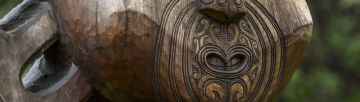
The first thing which blew me away was the main entrance, where there are 12 contemporary carvings, each representing a celestial guardian in Te Arawa culture.
As I wandered around the amazing Te Puia with my fascinating guide Patrick, he showed me the centre’s national schools of carving and weaving, where I watched the master carvers and weavers at work. It was great because I could ask them questions and see all the amazing creations the students had produced.
Patrick also showed me around the amazing geothermal activity in the Whakarewarewa Valley, with lots of bubbling mud pools and even a 30 metre high Pohutu geyser, which erupts up to 20 times each day. There are loads of other natural wonders to check out, including hot springs, boiling sulphurous pools and silica terraces.
I also learnt more about the story of Maori ancestors’ arrival and settlement in the valley, as well as their customs and traditions. The best thing about taking a guided tour is that many of the guides are descendants of some of Rotorua’s earliest people, and the stories they tell have been passed down through generations. It really is a humbling and fascinating experience.
Patrick also showed me around the interactive galleries, which explain Maori legend, and I saw a Kiwi bird up close in the specially lit Kiwi House, which is part of a national breeding programme.
There is a fully carved meeting house to explore as well, and all its designs, carvings and woven features were created by tutors and students from Te Puia.
The meeting house is the place to go for one of the three daytime cultural performances. Each 45 minute performance is a great way of enjoying Maori performing arts up close. I even got asked to join the stage for some poi dancing which was awesome, but it’s a lot more tricky than it looks! Poi is a traditional dance used by Maori women to help hand suppleness, strength and eye coordination. It was used to prepare young warriors for battle and is now used in dance celebrations.
I also had the chance to come back to Te Puia at night for the Evening Cultural Experience. It really is an enchanting place to be after the sun sets.
The evening began with a welcoming powhiri, a warrior’s challenge and a full kapa haka concert performance.
There was an opportunity to explore Pikirangi, a reconstructed pre-European village, where we enjoyed a delicious traditional hangi feast using indigenous ingredients, along with contemporary Maori dishes.
After that, we were taken outside to look at the Pohutu geyser under the stars, which was a truly magical experience, especially as we were sitting on thermally heated rocks so we didn’t get too cold!
If you want to learn more about Maori culture, Te Puia is definitely the place to come! You’ll be amazed and intrigued.
Te Puia can be found at Hemo Road, Rotorua, and is open seven days per week.
Te Po: indigenous evening experience runs daily from 6.15pm until 9.15pm.
For more information call 07 348 9047 or freephone 0800 83 7842. You can also visit www.tepuia.com